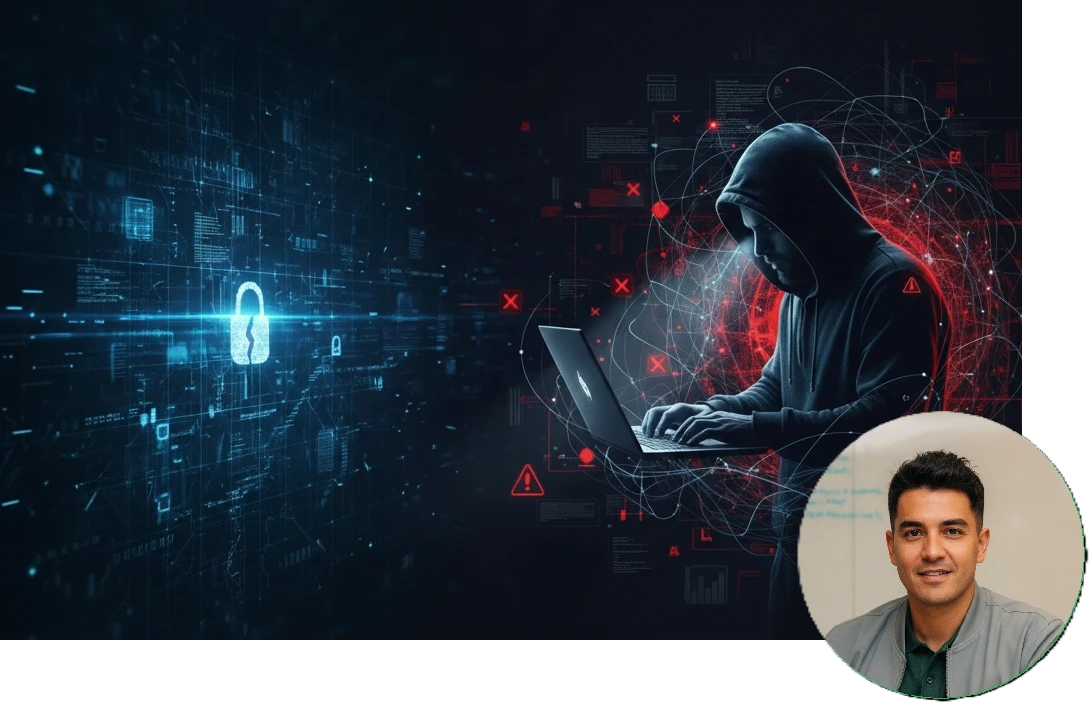
In the financial services sector, security isn't just a checkbox—it's the foundation of customer trust and regulatory compliance. While automated vulnerability scanners have become standard practice, they're only telling you part of the story. The question isn't whether you need scanning tools, but rather: what critical risks are you missing by relying on automation alone?
The Comfort of Automation (and Its Blind Spots)
Automated scanners are excellent at what they do. They work 24/7, they're consistent, and they'll catch known vulnerabilities across your infrastructure with impressive speed. For financial institutions managing vast digital estates, these tools are indispensable.
But here's the reality: cybercriminals don't think like automated scanners. They think creatively, chain together seemingly minor issues, and exploit the human and business logic elements that scanners simply can't understand.
What Human Penetration Testers See That Scanners Miss
- Business Logic Flaws
- Context-Aware Attack Chains
Imagine an online banking portal where a customer can transfer funds between accounts. An automated scanner sees properly configured HTTPS, valid certificates, and no SQL injection vulnerabilities. It gives you a clean bill of health.
A human penetration tester? They're asking different questions: "What happens if I manipulate the transaction amount after authentication but before submission?" or "Can I exploit the workflow to bypass transaction limits?"
These business logic vulnerabilities have led to some of the most significant financial losses in recent years—and automated tools will sail right past them.
Scanners identify individual vulnerabilities. Human testers identify *attack paths*.
Consider this scenario: A scanner flags a low-severity information disclosure issue on a subdomain and a moderate authentication weakness on the main application. Separately, neither seems critical. But a skilled penetration tester recognizes that information from the first can be leveraged to exploit the second, creating a direct path to compromising customer accounts.
This is how real breaches happen—through creative chains of exploitation that only human intelligence can simulate.
Social Engineering and Physical Security
Financial institutions aren't just digital entities. Your branches, call centers, and employees are all part of the attack surface.
Automated scanners can't:
- Test whether your help desk will reset a password based on publicly available information
- Determine if an attacker could tailgate into secure areas
- Assess whether customer service representatives are vulnerable to phishing or vishing attacks
Yet these human-centric vulnerabilities are precisely what attackers exploit to bypass even the most sophisticated technical controls.
Authentication and Authorization Nuances
Multi-factor authentication is implemented? Great! But:
- Can it be bypassed through API endpoints?
- What happens during the password reset process?
- Are session tokens truly random and properly protected?
- Can users escalate privileges through parameter manipulation?
These nuanced security questions require human reasoning and creative testing that goes far beyond pattern matching.
Third-Party Integration Risks
Financial services organizations rarely operate in isolation. Payment processors, credit reporting agencies, identity verification services—each integration point is a potential security boundary.
Human testers evaluate:
- Trust relationships between systems
- Data exposure across organizational boundaries
- Whether your security controls extend properly into third-party ecosystems
- Real-world scenarios where integration points become exploitation vectors
The Regulatory Reality
For financial institutions operating under PCI DSS, GDPR, SOC 2, or other compliance frameworks, penetration testing isn't just best practice—it's often required. But here's what many organizations miss: these regulations typically specify independent manual penetration testing, not just automated scanning.
Why? Because regulators understand that protecting financial data and systems requires the same creative, adversarial thinking that attackers employ.
The Bluedog Approach: Automation + Human Expertise
We're not suggesting you abandon your automated scanners. At Bluedog Cyber Security, we believe in a comprehensive approach:
Automated tools provide continuous monitoring and catch known vulnerabilities quickly.
Manual penetration testing provides the creative, adversarial perspective that reveals how an attacker would actually compromise your systems in the real world.
Our manual testing methodology includes:
- Reconnaissance that mimics real attacker behavior
- Business logic testing specific to financial applications
- Social engineering assessments tailored to your organization
- Comprehensive reporting that prioritizes risks based on real-world impact
- Actionable remediation guidance that your teams can implement
The Bottom Line
Your automated scanners are doing their job—but they're only covering one dimension of your risk landscape. The vulnerabilities that lead to headlines, regulatory fines, and lost customer trust are typically the ones that require human intelligence to discover.
In financial services, where the stakes couldn't be higher, can you afford to leave those gaps unexplored?
Ready to see what your automated scans are missing? Contact Bluedog Cyber Security to discuss how our manual penetration testing services can provide the comprehensive security assessment your financial institution needs.
Protecting your assets requires thinking like an attacker. That's precisely what we do.
Click for more information about our comprehensive Manual Penetration Testing service.